
Publications
All Publications
Showing 144 of 144 resultsWeekly Update 3: Quebec's First Election in the Age of AI
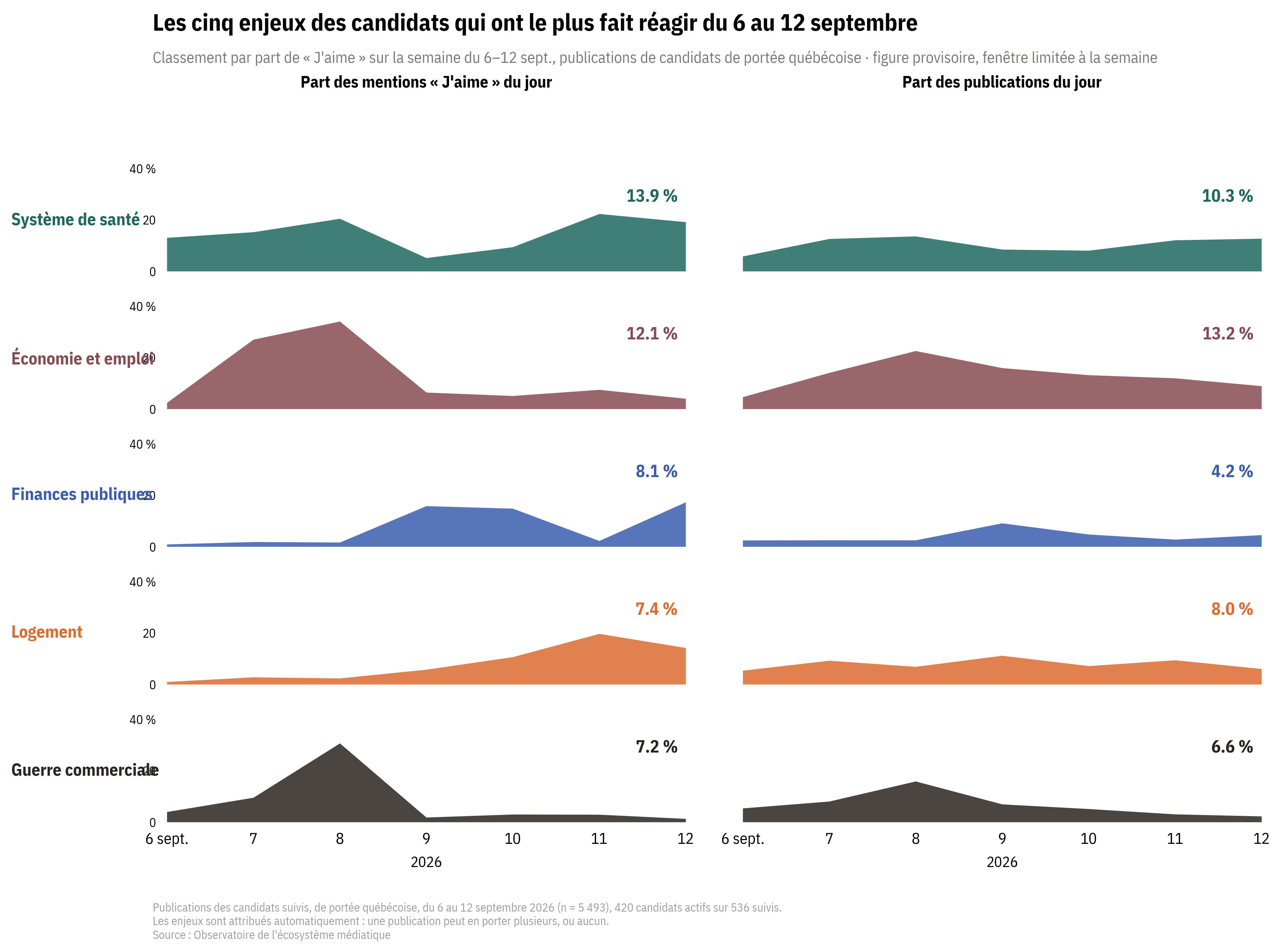
The third in a weekly series tracking the information ecosystem during Quebec's 2026 election campaign. This edition presents the results of an audit of the voting recommendations offered by ChatGPT and Google's AI Mode, showing how an anonymous AI-built website became a dominant source and how major outlets blocking AI crawlers is shaping the information voters are exposed to. The On Our Radar section covers vandalism of campaign materials, debates over the Coalition Avenir Québec's name, and discourse aimed at delegitimizing the electoral process.
September 2026Read more
September 2026Read more
Weekly Update 2: Three Agendas, One Election
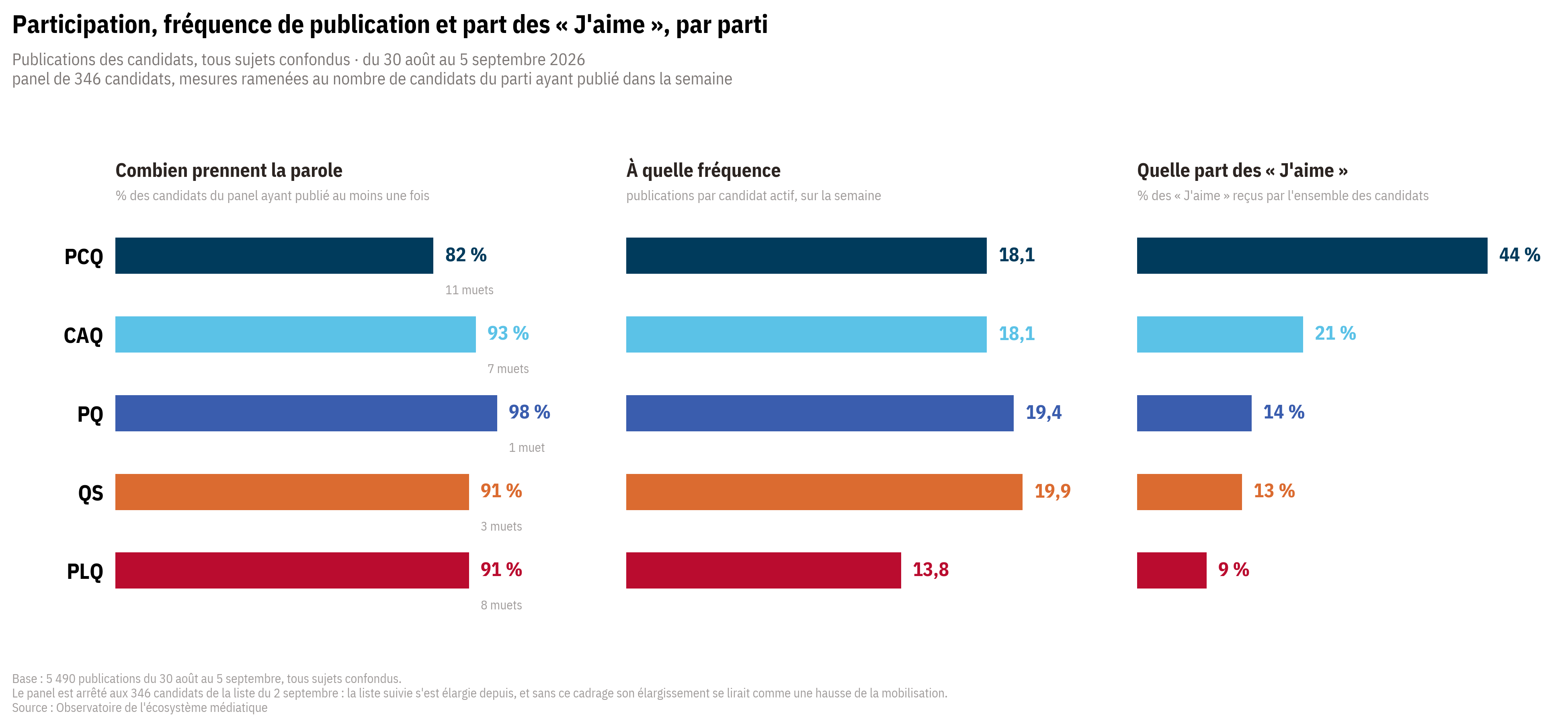
The second in a weekly series tracking the information ecosystem during Quebec's 2026 election campaign. This update looks at how candidates', voters', and online discussion's priorities have shifted from the trade war toward domestic economic issues, and compares the issues parties emphasize, the ones voters say matter most, and the ones dominating online conversation, finding three related but distinct agendas. The On Our Radar section covers allegations of federal government and La France insoumise interference in the campaign, along with discourse about the anglophone vote and hostility toward older voters.
September 2026Read more
September 2026Read more
Alberta’s Referendum, Online: Influencers, AI Content, Foreign Interest, and the Attention Economy Ahead of the October 19 Vote
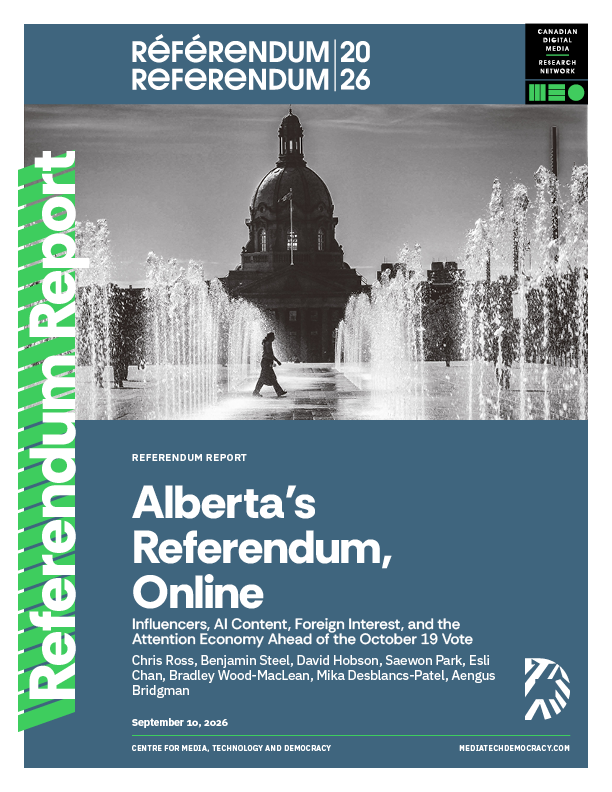
Alberta is heading into a referendum on October 19, 2026, in a rapidly changing information environment. Year-over-year, online influencers have been accumulating relevance and engagement at the expense of news media and elected officials, and we now have a case study of what a democratic vote looks like squarely in the influencer era.
The online conversation about Alberta's referendum is driven by a passionate community of 114 accounts, unencumbered by traditional forms of political accountability, that have captured roughly half of all engagement generated since January 1, 2025, across five platforms. Among these highly influential voices, pro-independence accounts outperform anti-independence ones by a ratio of roughly 8:1. Posts about Alberta separating from Canada, irrespective of position, receive more than double the engagement of comparable other-topic posts — an online Alberta Advantage.
A second major transformation has recently occurred as voters turn towards AI search and chatbots to understand the political world around them. However, these tools are still maturing and provide changing responses to common and important political queries in the context of the referendum. We find that Google AI Overview and ChatGPT give inconsistent, sometimes directly contradictory answers to the same questions. At the same time, AI-generated imagery is quickly emerging as a campaign tool in the information environment, and we find that the share of AI images among pro-independence posts on X has grown 3.5-fold since January 2025.
These new sources of information and campaign techniques are enormously consequential during this democratic moment. Most importantly, there is a striking difference between the online conversation and the general public of Alberta. While polling shows roughly two-thirds of Albertans would vote to remain in Canada, the online conversations runs the inverse with far more posts and online engagement from the highly energetic independence movement. A political movement without elected leadership, but with a dominant online presence that harnesses rapidly maturing AI technologies, is driving the public conversation on a referendum related to whether Alberta should remain a province in Canada. All of this is unfolding while confidence that Elections Alberta will run the vote fairly sits at just 59%. Our democratic institutions and understanding of the public square must keep up.
September 2026Read more
September 2026Read more
Weekly Update 1: The Trade War Enters the Quebec Election Campaign
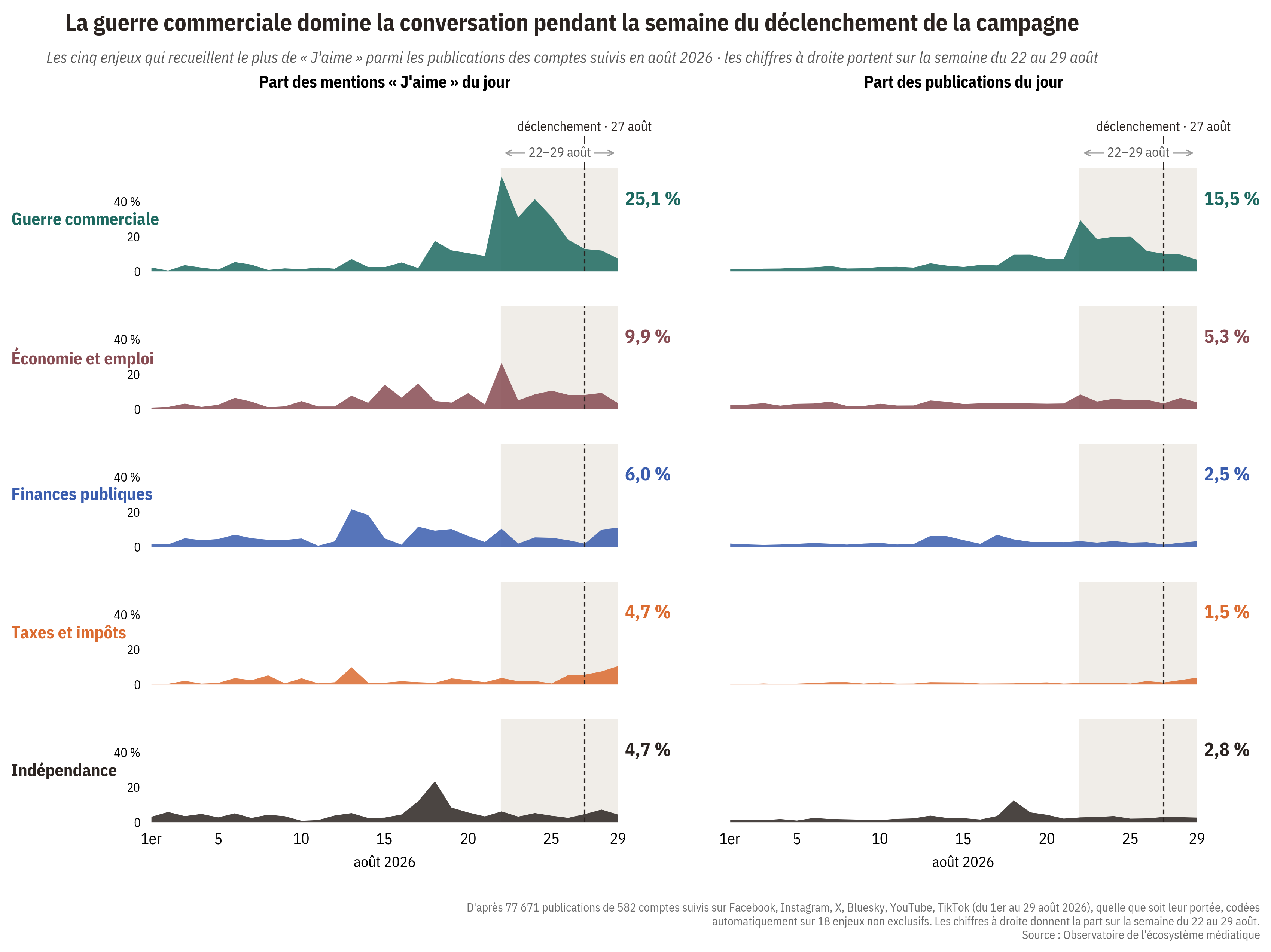
The first in a weekly series tracking the information ecosystem during Quebec's 2026 election campaign. This update looks at how the Canada–US trade war became the campaign's dominant issue — and how some online actors used it to question the election's integrity — plus a survey on Quebecers' trust in the negotiations, and a round-up of AI-generated leader videos, poll-neutrality debates, and Electoral Compass criticism.
September 2026Read more
September 2026Read more
An Independent Digital Media Ecosystem? Canada's Online Discourse in the Shadow of the United States
A national study analyzing over 8.8 million social media posts and a nationally representative survey to assess whether Canada's digital media ecosystem is independent of U.S. influence, finding that ecosystem independence varies by topic and time — Canadians drive the conversation when domestic news breaks, but a subset of Canadian influencers are closely integrated with their U.S. counterparts.
September 2026Read more
September 2026Read more
The Information Environment on the Eve of the 2026 Quebec Election
As Quebec's general election of October 5, 2026 approaches, this report provides a baseline portrait of Quebec's information ecosystem. Several factors make this context particular: the Alberta secession referendum, the trade war and U.S. midterm elections, the blocking of news content on Facebook and Instagram, and the mainstreaming of generative AI, which makes it easier to fabricate deceptive content. This report aims to better understand the types of information voters will be exposed to during the campaign and the perceptions they already hold toward institutions and their information environment. It addresses, among other things, media consumption trends, trust in institutions and the information environment, and the activity of candidates, media, and commentators across the various social media platforms. It also includes a synthesis of threats and vulnerabilities.
August 2026Read more
August 2026Read more
Identity Politicization After the Kirk, Tumbler Ridge, and Montreal Shootings
The online response to the June 2026 shooting in the Côte-des-Neiges neighbourhood of Montreal, which left three people dead, illustrates how information circulates during and after a crisis. As with many tragic events, footage, claims, and speculation began spreading across platforms within minutes. In this incident report, we examine how information moved through the online environment during the incident, in its immediate aftermath, and over the following days — and through that, how breaking news and public safety information reach and are interpreted by the Canadian public.
August 2026Read more
August 2026Read more
AI Unpacked: An Accessible Guide to Engaging Critically with Artificial Intelligence
AI systems increasingly determine what information reaches our screens, structure how we work and learn, and play a role in the decision-making that shapes crucial parts of our lives. Despite this, public understanding of AI is remarkably thin: conversations about it are too often dominated by technical jargon or inflated by hype, leaving people without the tools to critically assess AI's promises and risks. This has profound democratic consequences — it narrows debate, hinders informed decision-making, and allows powerful actors to steer the trajectory of AI with little public accountability.
AI Unpacked demystifies the building blocks of AI: algorithms, data, compute, infrastructure, labour, and the historical evolution of the field. It explores the social, ethical, and political challenges that accompany AI's rapid expansion — from bias and discrimination to mis- and disinformation, labour displacement, market concentration, and mental health impacts. It also introduces readers to emerging approaches to AI governance, including Canada's own regulatory landscape, approaches informed by Indigenous knowledge systems, and participatory models of policymaking that centre public voice and collective responsibility.
Organized in five parts with a glossary of key terms, each section opens with an introductory framing, compiles annotated summaries of foundational texts with every source hyperlinked for further reading, and closes with a set of key takeaways. The aim is not to settle debates but to offer a foundational toolkit: to help readers ask sharper questions, recognize what is at stake in current AI debates, and engage critically and constructively with the future of AI.
AI Unpacked is a collaboration between the Centre for Media, Technology and Democracy at McGill University and the Dialogue on Technology Project, the flagship technology and AI initiative of Simon Fraser University's Morris J. Wosk Centre for Dialogue.
July 2026Read more
July 2026Read more
The News Canadians Actually See: Redefining Political Information in the Digital Age
The Canadian news environment is being reshaped by platform decisions, shifting audience habits, and the rise of new voices in political information. This brief examines how Canadians consume news and define journalism, drawing on a national survey of 1,518 respondents and analysis of nearly 9 million social media posts from Canadian news organizations across multiple platforms during 2023-2025.
June 2026Read more

June 2026Read more
Online Harms AI Audit: Technical Brief
A technical audit of four widely-used AI chatbots (Google Gemini, Anthropic Claude, Meta AI, and OpenAI ChatGPT), testing their responses to harmful requests. The audit found significant variation in safety measures across products, with roughly one in three tests across all four resulting in harmful content generation. Conducted in relation to Canada's Safe Social Media Act (Bill C-34).
June 2026Read more

June 2026Read more
Online Harms AI Audit: Policy Memo
A policy memo accompanying the Online Harms AI Audit technical brief, outlining recommendations arising from testing four widely-used AI chatbots for safety against harmful requests, in the context of Canada's Safe Social Media Act (Bill C-34).
June 2026Read more
June 2026Read more
Facebook's News Slop Economy: Inside a foreign-run AI content-farm network monetizing fake news across Canada, the US, the UK, and Europe
A coordinated network of 340 Facebook pages, primarily operated from Vietnam, distributes AI-fabricated news stories targeting users in Canada, the US, the UK, and Europe. The network generates engagement through false narratives about politics, celebrities, and sports, driving traffic to fabricated-news websites monetized via advertising. Canadian public and private organizations inadvertently fund this operation through legitimate ad campaigns.
June 2026Read more
June 2026Read more